Sunday, August 29, 2010

My Online Writing Class


Sometimes, I’ve found, it takes just a single word or a picture to jump start the writing. A couple of connections, a spark, and BAM, the engine starts and I’m on my way. I knew that about myself somewhere in the deep ravine that doubles for my mind, but never really understood the concept until enrolling in an online writing class. And not just any writing class, either. I am a proud Wayward Writer and a member of the Literary Kitchen.

The class format runs like this. Each of the eight weeks during a session, our mentor Ariel Gore issues a short and a long assignment. The short is called a Quick Write. She offers a prompt like a word or phrase or photo, then we write for eight minutes, polish another minute then submit. I confess that I kept to the letter of the law the first couple of times and the results sucked. I let the time factor get to me and I could get out of my own way. What to do?

I noticed that a couple of submissions from the vets ran a little longer than might be expected for eight minutes. Example. One had a word count of 796 words. Even just straight typing, that’s a touch under 100 wpm. I couldn’t type 100 wpm for a lottery win. So I forgot about the time, totally. If it took an hour, it just took an hour. I’ve found, though that I can usually accomplish the mission in fifteen minutes with a three or four minute cleanup. Anything over fifteen, and I admit to the group that I cheated. This is not news, either. I told everyone in a conference call what I did.

The results have been startling. I’ve managed to be funny and powerful and poignant and insightful all in that fifteen minute time frame. Some of those writings have been better than things I’ve agonized weeks over. Some of the group, Ariel included, actually prefer my quick writes (particularly when it pertains to my boyhood) to my fiction. I confess I do, too sometimes. Going back and reading them, I’m astounded by how strong those experiences were. At the time they didn’t loom as large as now, probably because I was going through them.

They’ve made me a much better writer. Without question.

The long assignments I use for Catch a Falling Star or my short stories. I always get useful feedback.

The process of finding the class started in the Southlake branch of Barnes and Noble, the reference section, writing in particular. I saw the spine of a book with a long title, then ulled it off the shelf to see. How To Become a Famous Writer Before You’re Dead, by Ariel Gore.

I laughed. Opened the book and read a couple of pages. Bought it. Took it home. Read it from cover to cover. It touched me someway, somehow. I laughed. I cried. I learned. Because this book is unlike any I’ve ever read on the subject, more than 100 cover to cover over 30 years and parts of countless others. My particular favorite sections are when Rising Lit Star asks Magnificent Meteor. I won’t summarize the book here because you might want to read it someday, and I don’t want to take away any of the joy you might get from reading it yourself.

From there, I checked out Ariel’s website, saw the class listed, e-mailed her asking for a little more info. She e-mailed me back quickly with the info and I signed up.

That was one year ago.

I spoke last week of The Writerie, the writers group I belong to? This class is important to me as well. I’ve made some friends I’ll probably never meet face to face, and received wonderful critique. Notice I said, critique, not criticism.

And all of it started with a prompt. Seeing the book on the shelf. Buying the book. Reading the book. Joining the class. “Choose one of the following pictures and write a story around it.” That particular prompt generated one of the best stories I’ve written. I’m entering it into a contest this weekend (later today).

I didn’t intend this to be a testimonial for The Literary Kitchen, but I suppose it is. Or maybe just a reminder that generating kickass ideas is so easy its difficult. The Literary Kitchen takes away the difficulty. And I’m most grateful.

To Ariel: When I do become famous, I will tell The New York Times that you’re a genius.

Okay, I weighed 273 as of last Sunday, a total of 12 pounds down since August 1st. So far, so good.

My writing goals this week are to submit two of my short stories, and to pass page 125 in Lucky Thirteen of Catch a Falling Star.

I’ll let you know next week how I did.

Sunday, August 22, 2010

Writers Groups


To writers group or not to writers group, that is the question. I have my answer. Yes, but ...

Large writers groups are, in my view, to be avoided at all costs unless ...

To join a writers group is a personal choice. Steve Berry has been with the same writers group of four since he started writing seriously, and, even after becoming an international bestseller, stays with the same group under the philosophy, “Dance with the date who took you.”

I like that philosophy.

Stephen King, on the other hand, doesn’t belong to a group, but has a number of people he trusts to look at his work when he decides to open the office door. His wife is the number one person in that bunch. His “ideal reader.”

I like that philosophy as well.

I’m using both, and it is working for me.

My initial exposure to writers groups came when I joined one of the largest in the country. Its leanest times during my tenure boasted a membership of forty, its strongest, just a shade under a hundred. The advantages seem obvious, particularly when a number of those writers are published several times over. I confess that I goo-goo eyed a lot of those folks, and I got a lot out of it. I learned a lot about the industry, at least from their point of view.

The disadvantage is the same, a lot of different perspectives. For the most part, people in the group wanted you to do well. Others not so much. Many offered critique. Some offered outright criticism with smiles on their faces. Having been on the board of this group, I was privy to a number of conversations, and one that made my jaw drop was how one of these fine and lovely folks bragged about how his comments drove away a new member of the group.

“Hey, if they can’t take the heat, they need to get out of the kitchen.”

I’ll buy that, but there is the natural heat of the kitchen, and then there is arson. And this “gentleman” and a couple of others were pyromaniacs. After having driven home, delicate confidence totally shot a few times, I started to see what was happening and ignored most of their criticism. I don’t believe in stealing someone’s dream. The industry itself will determine whether someone should or should not be published. It doesn’t need any help.

I may have mentioned this in previous blogs, but I believe very much in critique and not at all in criticism when it comes to writers groups.

Critique is when you say, “This isn’t working and here’s how to fix it.” An example would be, “Your lead character isn’t sympathetic early on. You can give him a lot of sympathy by giving him a dog and show him petting it.”

Criticism is when you say, “I don’t like your main character. I’d never buy a book about a guy like that.”

Thank you for sharing.

Chances are high that both types are available in large groups. Ultimately, there will be five or six you really connect with.

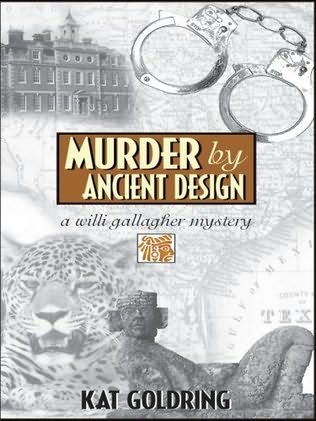
Now, the ideal group is the one I currently belong to, big surprise. We are five who connected. We call ourselves The Writerie, and consist of Kat Goldring, author of the delightful Willi Gallagher mysteries (see the cover above), Glenna, Shirley, Jane and myself. We have the advantages of the larger group in that we all have knowledge we can share with the others, but without the meanness of the large group. We’re supportive, and believe strongly in critique, not criticism.

Criticism comes when the book is published.

We meet twice a month and read our work-in-progress to each other. And trust me on this. When I’m on the bestseller list, I’ll still be making my twice monthly sessions to The Writerie. These folks are SOOOO good to me and SOOOO supportive of me, that if I don’t get published it will be my fault. I hope I’m that way for them. I certainly want each of them to be on the bestseller list.

I’ll be talking more of these wonderful writers later on and at various times. Add to that my amazing friend Dawn, a brilliant writer I also want to see on the bestseller list. She has her own group and lives in Edmonton, but the two of us routinely swap pages and tell each other when we’re brilliant and why, and when we’re not-so-brilliant and what we can do to make it better. In other words, critique.

I’m also a big fan of the RIGHT online writing class. More on that next week. :-)

I’m now 85 pages into luck draft 13 of Catch a Falling Star. And I’m looking to make a lot more progress this week.

Thanks for the indulgence last entry. I do appreciate it. So here’s the update. On August 1st, I weighed 285. On the 8th, I 280. On the 15th, 276. So much for the water weight. Now is when it gets tough. I have to stay focused.

I’ll let you know next week how I did.

Sunday, August 15, 2010

A Journey into the Personal


When I started this blog, my intention was to stay focused exclusively on my journey toward publication. In essence, the writing, the submissions, the rejections, and, ultimately, the acceptances. The goal, then, was to stay clear of the personal except to the extent that it had to do with the world of writing.

Oh, I intended to drop emotion on the page, if I could. To celebrate and/or cry at the results of the process itself, but not the life things that affect the writer ... me. No one wants to read a writer’s angst bullshit splattered all over the page or screen, unless it’s in the form of a well-told tale. I suspect that Stephen King’s Misery came about that way.

So, doing this blog the way I originally intended would have been phony at worst, incomplete at best.

Ultimately, though, one cannot have the journey without the ancillary creeping in like bitter into tea. Be that as it may, I’m going to TRY to make this a little more like chocolate into milk, but either way, here goes.

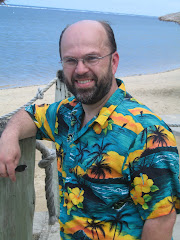
When I left for Fiji in March 2008, I weighed in at a svelte 185 pounds, a workable twenty pounds overweight for my height. I felt good. My famous (or infamous) aloha shirts hung down past my hips as they should to allow those trade winds to slip underneath. I swam an hour solid three times a week. The pictures of me on this site were taken during that trip, including the one above.

On August 1st, 2010, two weeks ago today, I tipped the scale at 285 pounds, the most I’ve ever weighed in my life, at the age of fifty-two, an age where many healthy folks suffer heart attacks and strokes.

One hundred pounds gained. Holy shit!

No aloha shirts. None fit. No self-respect either. And heart flutterings that have since gone away, but not forgotten. Then I understood, perhaps for the first time, a Benjamin Franklin quote, “Nine men in ten are would be suicides.”

So, while I would love to be compared with Hemingway, I don’t want it to go THAT far. Then several circumstances occurred within the last few weeks that tipped the balance a little. Okay. Tipped the balance a LOT.

First, I had a customer ask me on the phone at work if I was okay. She said I was breathing heavily and wheezing. I THOUGHT I was breathing normally. But how could I have been at 285 pounds.

Second, I read about the death in April of the father of two of my childhood friends, David and Bobby Tamura ( he goes by Bob, now, from what I read). I always held Mr. Tamura in the highest regard and respect. When I would become lazy, or otherwise annoy him, he would laugh, shake his head and say something on the order of, “Rocky, Rocky, Rocky. What am I going to do with you?” When I saw his obit picture, I heard him say it again, as he last did in person nearly thirty-five years ago. He died having been the first person to whom the U. S. Judo Federation ever awarded the rank of Ku-dan, or ninth dan. Only 15 people in the history of the sport have ever been awarded the tenth dan.

Third, last Sunday evening I had a long phone chat with my friend Cathy Rosczewski. Well, it started as a conversation and ended as a Rocky monologue about how I’d never attract a woman in my life blah, blah, blah. I exhaled self-pity. And I hate self-pity. Just abhor it. And I wasn’t even drunk. I’m so sorry to have spewed that kind of bile all over her, and she was so patient in hearing me out, yet again. I’ll have to apologize to her and thank her in the same breath.

I will when I have the courage.

But she did mention, yet again, that I lacked confidence in myself, and I took us around the mulberry bush, yet again, by saying that you had to experience success to have confidence, blah, blah, blah. And, truth-be-told I’m probably never going to have confidence in myself as a man. I can accept that. But I sure-as-hell can have confidence in myself as a person and as a writer.

Make book on it.

And that’s where I start. I can lose the weight. I’ve done it before. Hell, I’ve lost thousands of pounds over the decades. I’ve even been able to keep it off for years at a time. The problem this time is that I lack focus and accountability. That happens when you get older.

So, here’s the deal.

I’m giving myself one year from August 1st to lose one hundred pounds. That’s about two pounds a week, well into the safe zone for weight loss. The focus will come from my conviction that if I haven’t fallen into the safe zone, I’ll resort to surgery. Plain and simple. The accountability is that while I’m writing about character and story and submissions and how far along I am on lucky draft thirteen of Catch a Falling Star, you will see notations on my weight loss progress. A paragraph here and there. Not huge entries. I hope this is the last time I devote a weeks blog to this. But it will be there in the shadows.

In the past, I’ve used a lot of things to motivate me to lose the excess weight, everything from puppy love to acting. So, this time I’m choosing threat of surgery (cutting me open like a cod fish), and weekly blog entries (stripping myself naked). I don’t want to use the ultimate one. At least not yet. But I hinted at it earlier, so I’ll mention it here.

I want to live, and I’m killing myself.

There. I said it. Not easily. I’m going to have to dry off the desk and my shirt when I’ve posted this, but folks, I've been killing myself for more than ten years. Slowly, sometimes painfully, sometimes with a smile on my face, but I’ve been doing it. It’s time to face the fact that my mother and sister are dead, and I have to keep walking down the road.

I want to keep walking down the road.

I crave the adventures, not just in the stories I tell, but in life. So, I may be asking those of you who read this for a little help from time to time. And from others, too. I would be most grateful. And I promise always to reciprocate.

There it is. My heart on a plate.

Please tread gently.

By the way, I wrote a pretty decent 2,500 word short story this week about a family who, once upon a time, had it a whole lot worse than I’ve had it.

I am pretty lucky all things considered. And I learned something else, too, this week. Right now, actually. I can seriously bust pages when I want. I cranked out the first draft of the short story in a day. This blog entry will run just over twelve hundred words, and I wrote it in less than an hour and fifteen minutes. That includes thinking time.

As always, thanks for reading. I’ll let you know next week how I did.
Sunday, August 8, 2010

To Outline or Not to Outline


The jury is still out, but I think I’m a convert to the yes side of a controversial technique in writing ... outlining. For years, I listened to the battle between John Saul and Terry Brooks (pictured) at the Maui Writers Conference. The one (Terry) touting the inherent story organizational qualities of the outlining, bringing the story step by step to the climax, while the other (John) swore to the surprise quality of spontaneous writing. “If I don’t know what’s going to happen, neither will the reader.”

Neither guarantees a great read if the story sucks, though. Both admitted that. And, as an aside, I’m missing those battles every year even though I thought they were petty at the time. Amazing the difference between petty and fun given the salve of time. Whew. I don’t know what happened to MWC, but what a good thing it was, and now it’s no more.

I remember Terry saying in his T-shirt, shorts and sandals. “Try my way. Just once. If you like it, keep it. If not, no harm done.”

So, as you wonderful followers of my blog already know, I have been outlining my novel Catch a Falling Star these two weeks and have loved the result. For the first time in twelve drafts, I can see the forest of my novel, the overall layout rather than walking from one tree to the next to the next, unable to peruse the whole of it. Wow! But even though draft thirteen is outlined, I’ve given myself permission to revise it as the story steams down the railroad track. Who knows, the characters may want to take me in a totally different direction. If so, I’ll stop there and revise. I love the old folk song “The Wreck of the Old ’97,” but I don’t want it to be my novel.

Damn, I really think this might work.

My next statement is going to sound like I’m straddling a fence, and maybe so, but my gut is telling me, ultimately, to use both. Just plow through draft one as John Saul would, putting the sweat and guts and tears and laughter on the page. Then, go back and analytically organize the story ala Terry Brooks. The Saul/Brooks method, I’ll call it. Gotta love it. Hey, I enjoy both of their stories. Both have sold millions. I can’t, in truth, disagree with either with credibility, but I can employ both. And am.

I’m one with the outlining process now. A single 3 x 5 index card per scene, and a flow chart of the entire novel. I’m stylin’. :-) Simpatico with the process. I can see the whole thing like I was in a helicoptor flying over Black Rock (Kaanapali beach on Maui). The prologue flowed pretty easily, as did chapters one and two. Chapter three is a little more difficult because I’m bringing back an event from later in the novel to the front ... thanks, Bonnie. But it’s coming together well. I’ll finish that today and move on painlessly to chapter four.

Obviously it’s too late on this one to do a single draft. Unless one could argue that I’ve done a dozen single drafts. But I sure can finish this one and polish it and start sending it out, then on to my NEXT NOVEL. And I’m looking forward to that day. More than you can know. I’d fallen into what Steve Berry (with whom I studied) said was the state where you hate your novel, you see.

And I was so there.

But with this outline, I’m back to looking forward to being with my characters again. Catch a Falling Star is a rite of passage for four people and I have to get them through, just as the actor Edward G. Robinson once said that he gave each character he played everything he had because he “owed them that.” And I owe it to them. I gave them life. And I need to give them every chance to live their lives between the covers of a book.

Every chance.

Oh, yes. I’m a convert to the outline while still a believer in spontaneously spilling everything on the page. And so I’m on to finishing chapter three then four and onward. I really am looking forward to continuing this afternoon. I’m jazzed. Six weeks? Maybe less?

And then ...?

My next lead character will come from one of two prospective novels, and will be named Miranda or Laura. I’m leaning toward Miranda. But I think they both ROCK! I can’t wait to spend time with both.

I’ll let you know next week how I did. And thanks for all of your comments. I appreciate each of them.

Saturday, July 31, 2010

The Password For Today Is ...?


Some idiot once said that, “Genius is one percent inspiration, ninety-nine percent perspiration.” That idiot was Thomas Edison, and as the years go by the more I think he has an argument. And, of course, he wasn’t an idiot. I’m currently writing under the light of his genius.

For years I waited for inspiration to strike before sitting at the typewriter/word processor/desktop/laptop. Sometimes it hit. Most times not. And then I was left staring at the last sentence of an incomplete story or worse, a blank screen.

In 1999 I attended my first Maui Writers Conference and heard words from Australia’s Best Selling Author Bryce Courtenay (above) that were at once funny and profound. “Bum glue,” he said. The act of securing one’s ass to the seat of a chair and write, dammit, write. No, that’s not quite accurate. The act of securing MY ass to the seat of MY chair in front of MY laptop and typing one word after another until a story unwinds on the page. I have to apply these precepts to me, you see, if I’m going to get anything out of them.

So, for me to achieve Edison’s ninety-nine percent perspiration, I need a healthy dollop of Bryce Courtenay’s bum glue.

Having really done well with the new outline for Catch a Falling Star, I’m going to now give the bum glue a chance. On the evenings of the days I work, no television. Not even a ballgame. If it’s my beloved Texas Rangers, well, they will pull my focus and I won’t write during those precious two to two and a half hours I have from the time I get home from work until I go to bed. If it’s another team, an exciting game could divert me. If it’s a cooking show, “Damn, I definitely need to know how to fuse chicken tandori chili mac with a pineapple raisin right side up cake.”

So, NO television on the evenings after I get home from work. Period. What I will use is music. The ethereal strains of Enya, or the hard pumping rock and roll of any number of bands, or whatever my mood strikes me to ease my mind into the story, because I’m starting to believe that if I force myself to write three sentences, just three sets of subject/predicates, the muses will wake up and help me fly around my inner world grabbing this scene and that sequel for the story.

I am also starting to accept that working on the story itself is writing, too. Somehow, I’ve never really accepted that organizing scenes and braiding story lines is fully as important as dialogue and description and theme and metaphor. Stephen King says in his book On Writing that he usually produces two drafts and a polish per book. I want to be able to do that. Or at least be able to come in mid-single digits.

Bum glue. It all comes down to bum glue, doesn’t it? Bryce Courtenay writes twelve hours a day six days a week seven months a year. Stephen King aims for two thousand words a day. Lawrence Block, five pages.

Given my work schedule, I haven’t expressed my goals like they did, and don’t want to now. I’m happy that I’ve written every week. Now it’s time to make that every day. Every day. Every day. And I have worked on writing every day since my last post.

Okay, I didn’t work on it much the day my aunt and I went to the Beau Rivage in Gulfport for some battles with the one-armed bandit. I lost forty bucks. She broke even. And I might have missed a little time while introducing her to the Twilight movies. But I did some work every day.

I’m going to try one thing before getting back to the story proper, and that’s to devote one page per chapter to organize the actions and my thoughts. I don’t know yet, but I think it might help add more detail and depth. I’ll let ya know how it works. Regardless, I desperately want to get back to work on the manuscript itself, and, of course to those amazing assignments given by Ariel for us Wayward Writers.

And this morning I head down to Cleburne to The Writerie and Kathy, Glenna, Shirley, and Jane. I’ll have my revisions to do from that meeting as well.

So to accomplish all of this, I have to stay in my chair in front of my laptop as much as possible.

The password for today, then is “bum glue.” Okay. That’s two words. :-)

I’ll let you know next week how I did.

Tuesday, July 20, 2010

Patience is a Craft


So what is the craft of writing? It encompasses many elements stated in many ways. What I’m going to try to do is to state a few of those I think I do well, and a few I don’t do so well ... yet. This post won’t be complete, obviously, as volumes have been written on each element. I own most of them.

First thing is to set the scene, and I think I do that pretty well when I take the time to walk through and experience it in my imagination. Night is best to do this. I just put on some music to establish an appropriate mood, close my eyes and envision a castle, a bar, a jungle, whatever and write what I see, hear, touch, taste, smell as concisely as possible.

That’s the ideal.

Where I go wrong is when I don’t spend as much time in the location as I should. What I try to do then is overwrite it. This leaf blew to a spot just beside the third largest of the seventeen bulges of the root system of the oak tree, that dandelion set two inches from the dividing line between the Carson’s Victorian house with all of the shutters in place, and the ... you get the idea. When I spend enough time in my location, I can pull out its essence and throw it out there in a few sentences that hopefully resonate. And it only takes a few sentences, because most times only a couple of the senses are engaged at a time. More importantly, though, I’m not necessarily trying to get the reader to see the exact image I’m seeing. I’m trying to get her or him to see something similar that makes sense.

THAT’S what I have to always keep in mind. Use the reader’s imagination. Tap into that amazing, wonderful resource. I got this notion from the Australian author Bryce Courtenay who recommended this very thing, but in different words. He said that in a romance, do we really want to give our hero blonde hair and blue eyes? What about women who swoon over brown haired men with those wonderful chocolate browns? What about the red haired, green eyes lovers? If we just capture the essence of the man, the readers imaginations will fill in the details that s/he wants and be totally enthralled.

Of course, he also said that in a mystery, we may need to indicate that someone has blonde hair and blue eyes. So the level of description depends on the type of story. Need to know basis.

The next element I think I do pretty well is dialogue. I do this using a touch of schizophrenia I acquired from my acting days. In a two person scene, I take on both parts and speak the dialogue out loud. If it makes sense and sounds like the character I’m trying to create, then I go with it. Again, I close my eyes and try to get a sense of who these characters are and what idiosyncrasies I can exploit. Because each of us has his or her own speech patterns. Unique speech patterns, when blended with body language. Like a character might wipe his or her forehead before delivering bad news. Or a character might have a particular speech quirk. He or she might start, then pause after a couple of words, then start again when delivering bad news.

Where I get in trouble with dialogue is when I get lazy and make the characters sound like me, or, worse yet, the narrator. I’ve been known to do both. When this happens, the characters come off flat and one dimensional. There are many great creators of dialogue, but the best I’ve ever read for making speech patterns unique to the characters is Dickens. As the Harry Potter novels moved on, I thought J. K. Rowling really came into her own using dialogue to distinguish characters. Great dialogue just enhances a great story and gives it depth and breadth and character.

My biggest challenge for improvement is organizing the plot and subplots into a logical upward movement to the climax. With all of the detail, I literally can’t see the forest of the trees. Forest? What’s that? Story? What’s that? I can only see this Jerry and Christine scene. Or the one between Shirley and Croft. And that’s it. My challenge was to get into a plane and fly over and look down. Ah! Forest! So that’s what it looks like!

I did this by taking letter size legal paper and dividing it into four columns, one for each of my viewpoint characters. Starting with the prologue, I put a one sentence description of the scene in the column for that viewpoint character. The next scene goes on the next line under that character and so on. I was amazed by what I saw. Oh, wow! So poorly structured. The beginning was fine. The ending was fine. But the subplots went up and down like a boat in a confused sea all the way to that ending. I needed a build of each of the subplots to a where the climaxes occurred fairly close together. Like one huge wave breaking on shore. Like fireworks. The flight to the sky (build), the explosion (climax), the fade away (dénouement).

I’m slowly getting a handle on story structure, and am focusing on this in draft thirteen. On this, I can’t get in a hurry which would be my nature. Get to the writing! Go for it! NO! I have to outline from start to finish. The emotion and character is there. I have to cultivate the patience to outline. Once I finish this, I have so many other wonderful stories to tell.

Yes, I can summarize the solutions to my challenges in one word.

Patience.

Patience is a craft.

Continuing on with the outline, and am excited about it. Come back Sunday August 1st and see how I did.

Sunday, July 18, 2010

True Ease in Writing Comes From Craft, Mr. Pope


Writing is a craft. Period. That’s the only way I can look at it and do my best. Seeing writing as more than that, seeing it as, say, art, would set me above the writing making me incapable of doing it well.

In my view, writers should never see their work as art, at least until it is on the shelf, and certainly not in the creative phase. It’s hard enough choosing the right word, the right description, the right story element to worry about that elusive something that takes a tale into a higher realm.

I am speaking of prose, here. Not poetry. That’s different. And as the current draft of Catch a Falling Star is lucky number thirteen, I’m still struggling with the craft. Thirteen drafts? Complete rewrites? What business do I have trying to cram art into it, assuming I even know what that means?

I have spoken to several writers, unpublished, who describe themselves as artists. A noble ambition, perhaps, but premature on the one hand, and downright elitist on the other. At least to me. But then again, every time I see a picture of Rodin’s The Thinker, I can’t help but feel that the dude’s constipated (see attached image). So take my view for what it’s worth.

I’m saying that art is a consummation devoutly to be wished, but in writing can only be defined in the hearts and minds of the readers. It’s the reader who determines whether a story is art, not the writer. And I believe it’s the individual reader as well. Not the reader as a collective entity.

As an example, I love Dickens’ A Christmas Carol. I read it most every year, and watch at least one of the filmed versions around holiday time. To me, it celebrates the light of the human spirit by showing us the dark -- with a little bah, humbug stinginess along the way. In other words, art -- for me. Someone else may read it and say, “It’s about the redemption of an old coot.”

And that’s fine. That’s the beauty of diversity. The beauty of drunken brawls over the true meaning of existence or the shelf life of a Twinkie. A British gentleman I met in England told me that American football contains artistic elements. As an example, the long pass. “Your quarterback throws the ball,” he said as though it was taking place in front of him, “not to where the receiver is, but where he’s likely to be. When the ball falls into the receiver’s hands in stride, it’s a thing of beauty. It is art.”

I like football as much as most dudes, but I wouldn’t go that far. But it doesn’t matter really. To him, it was art. To me, not so much. Though I’d love to see the Cowboys do that a little more this year.

Bringing the ship into port, I just want to tell a good tale, and let the chips fall where they may. If I tell the best story I can, and people like it, and I make a good living off of it, that’s the absolute best I can hope for. Art is irrelevant to the process.

I’m not going to lie. One thing I dream of, and many writers dream or should, is someone writing or walking up to me one day and saying, “Rock, your story is art at its finest.” Immediately after silently questioning their taste and/or sanity, I will say something like, “Thank you. I really appreciate that.” And I will mean every word.

Because every writer wants her or his story to be read and create an impact of some sort on the reader. So, for me, there would be no difference between the above compliment, and “Dude, your stories rock!” And while the above “art at its finest” patron would see The Thinker as Rodin’s masterpiece, the “your stories rock” fan would agree with me and offer that poor man some Ex-lax.

As I’m visiting my aunt and cousins on Wednesday, I will post next Sunday’s entry Tuesday evening. And it will be on craft.

I am continuing on with my outline, and am liking it.